
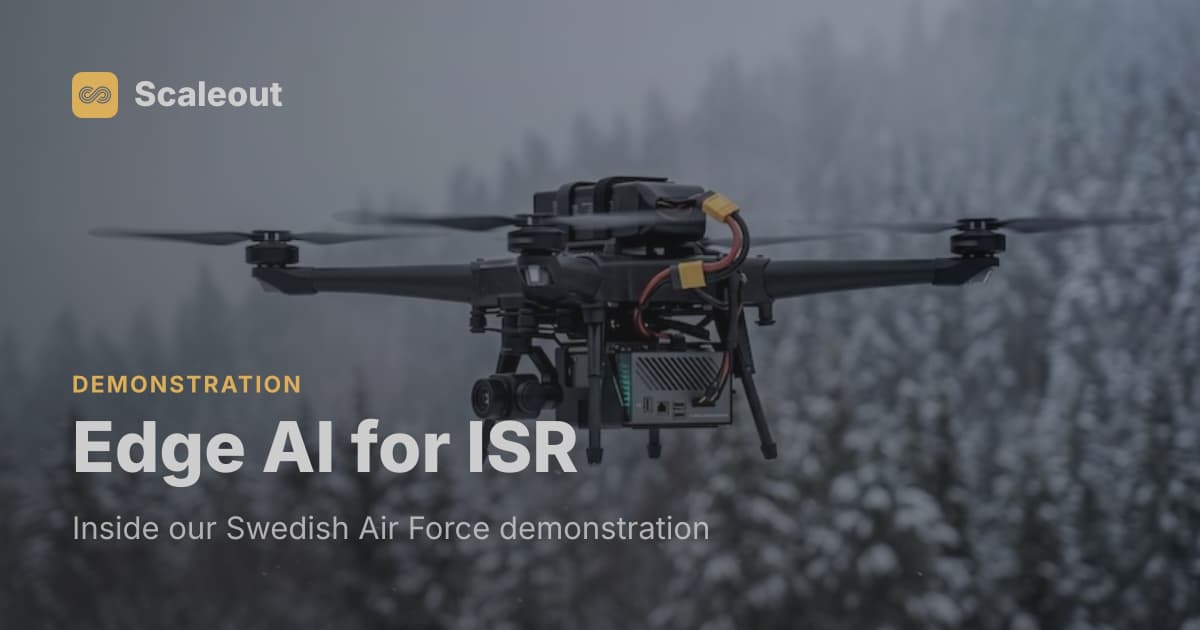
In modern defense and ISR operations, the tactical edge is unpredictable. Network connectivity is never guaranteed, and static AI models trained on vendor datasets quickly become obsolete in the field. As part of our engagement with the Swedish Air Force, we recently demonstrated our Tactical Computer Vision Network (TCVN) built to operate through Denied, Disrupted, Intermittent, and Limited-bandwidth (DDIL) conditions. The demonstration ran live at the Air Force's base in Uppsala (F16). The demonstration was conducted as part of an evaluation of Scaleout Edge under an active engagement.
The demonstration ran a two-node scenario:
- A forward-deployed Vision Ground Node (ALPHA) ran at the airbase alongside the Air Force team, and
- a development node (BRAVO) ran in our lab in central Uppsala.
Both were managed by a cloud-hosted Scaleout Edge Control Plane. The architecture spans the full tactical hierarchy: a control plane orchestrating fleet ModelOps, "Far Edge" ground nodes running real-time inference and local training, and "Device Edge" AI companions running on-board drones for autonomous last-mile inference.

Graceful degradation in DDIL environments
Network resilience was a core focus. We held ALPHA at the airbase on a stable link and stressed the BRAVO node in the lab, simulating severe degradation and then complete disconnection. The node kept operating on its own: local inference and active-learning pipelines ran at full frame rate, logging detections locally while the link was down.
When the connection returned, the system executed a prioritized backfill instead of dumping everything at once:
- heartbeat and health data synced first, then
- critical alerts and drift notifications, then
- model updates with full provenance, and finally
- bulk telemetry.
Observability degraded gracefully. Operators lose resolution before they lose visibility, and the offline node's last-known state stays on the fleet view until fresh data arrives. Throughout the outage the node kept learning, then rejoined the fleet once the link came back.
Sovereign fleet learning
The demonstration centered on Sovereign Fleet Learning. Raw surveillance data never leaves the edge node. Each node uses active learning to select high-value, uncertain frames, annotates them locally, and fine-tunes its model on-site.
When connectivity allows, these local model updates are aggregated via Federated Learning into a global model that learned from both nodes' data, without either node's raw video crossing the network. The global model is then staged back to the fleet and compared side by side against the previous version. Every deployment becomes a training opportunity, and data sovereignty is guaranteed by the architecture rather than by policy. For a national force, that means surveillance data collected at the airbase stays at the airbase, while the fleet as a whole still gets smarter from it.
C2 integration
The TCVN augments existing operator workflows instead of replacing them. The system is an AI "sidecar" to Command and Control (C2) infrastructure. Through OpenTAKServer integration, real-time detections are published as Cursor on Target (CoT) events, and live video feeds with inference overlays are shown among the OpenTAKServer Streams which can be distributed to ATAK/iTAK clients. The AI capabilities flow into the systems operators already use. The same pipeline applies to adjacent missions: we ran a counter-UAS (cUAS) variant on a separate sensor, and the model and workflow transferred unchanged.
The strategic takeaway
Access to the best models is no longer the sole differentiator. The critical capability is being able to confidently operationalize the state of the art and adapt it to current operational data.
By running this infrastructure inside its own environment, the Swedish Air Force can reduce vendor lock-in, sustain continuous AI adaptation in the field, and keep decision superiority even when operating disconnected. The demonstration at the Uppsala wing was an early step, and the same model lifecycle scales from a single airbase to an entire fleet.